If you've been reading about the Twin Cities housing market this year, you've absorbed a fairly consistent story: tight supply, quick sales, sellers holding the leverage. That story is true for most of Minneapolis. It is not true for the Mill District.
Pull the numbers for the 55415 zip code, the heart of the neighborhood's condo and loft stock, and you get a market that looks almost nothing like the one described in the citywide reports. Longer time on market. Lower sale-to-list ratios. Almost no bidding wars. The Mill District isn't underperforming. It's playing by a different set of rules, and understanding why matters more than the median price if you're actually trying to compare this neighborhood to anywhere else.
The Gap Between Two Markets in the Same City
In May 2026, sellers across the broader Twin Cities metro were fetching somewhere between 99.7 and 101.3 percent of list price, with supply sitting under three months in most reports. That's the definition of a seller's market: buyers competing, offers landing at or above asking, homes moving fast.
The Mill District's own numbers, tracked through the 55415 zip code in mid-2026, tell a different story:
| Measure | Twin Cities / Minneapolis (May 2026) | Mill District, 55415 (mid-2026) |
|---|---|---|
| Months of supply | Under 3 months | About 5.5 months |
| Average sale-to-list ratio | 99.7% to 101.3% | About 97.3% |
| Share of sales closing above asking | Common in a tight market | About 6.7% |
| Median days on market | 45 days (metro average) | 46 days |
Median days on market are nearly identical. Everything else diverges. A buyer touring the Mill District right now isn't stepping into a bidding war. They're stepping into a market with actual room to negotiate, sitting inside a city where that's supposed to be rare this year.
Why a Condo Zip Code Doesn't Follow the Citywide Script
The instinct is to read that gap as a warning sign, as if the neighborhood has cooled. That's the wrong read. The Mill District behaves differently because it's a fundamentally different kind of housing stock, and different housing stock responds to different pressures.
Every unit here is attached housing. There is no single-family comp to anchor prices, no lot size or yard to add variability the way suburban listings do. That sounds like it should make comparisons simpler. It does the opposite, because it means every sale is really a sale of two things at once: the unit and the building it sits inside.
Buildings carry costs and conditions that a citywide median can't capture. HOA reserve health varies by association. Financing overlays differ depending on a building's owner-occupancy rate and how its documents are structured. A unit can be priced right and still take longer to close if a lender flags something in the building's paperwork rather than the unit itself. None of that shows up in a "months of supply" headline, but it shows up in every individual transaction, which is exactly why the aggregate numbers here run slower and softer than the rest of the city.
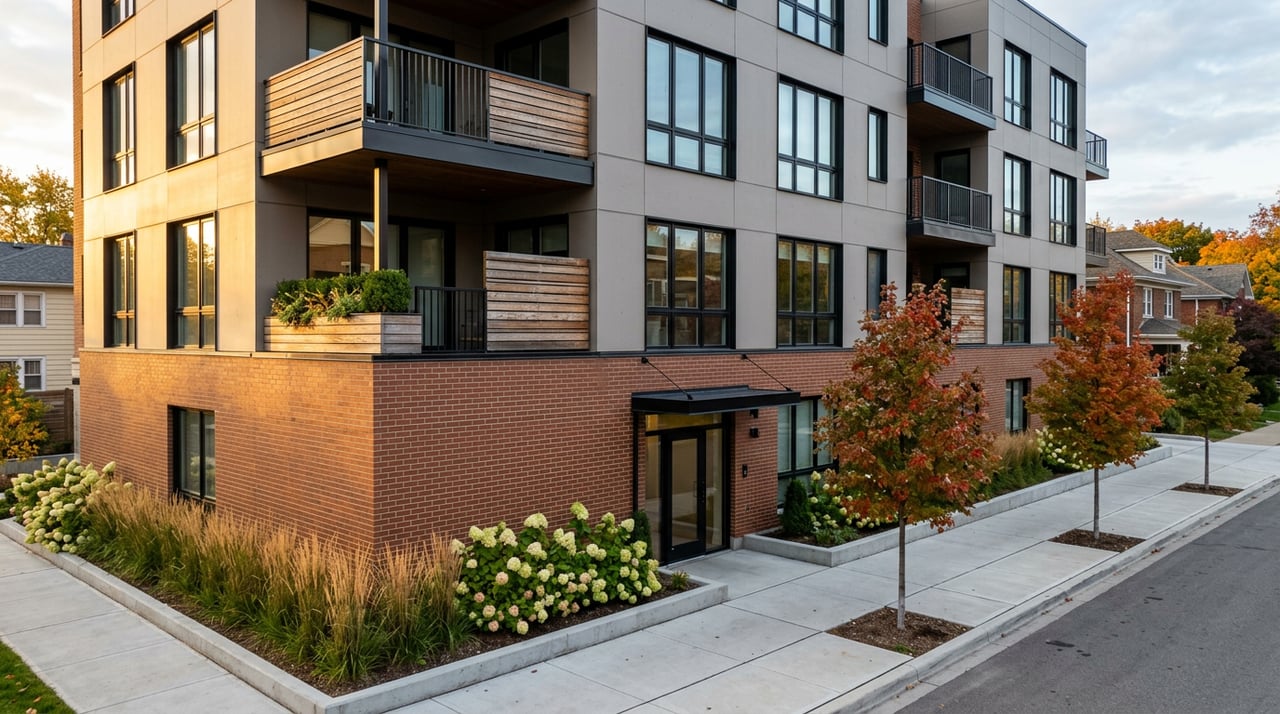
Then there's the age spread. This is a neighborhood where a flour mill converted into lofts in the early 2000s sits blocks from a glass tower finished in the past decade, and the two properties are not competing for the same buyer. A 19th-century mill conversion with exposed brick and timber beams and a 21st-century tower with floor-to-ceiling glass are different products wearing the same zip code. Treat them as one market and the comparisons stop meaning anything.
The Median Price Is Blending Two Different Buildings
The Mill District's median sale price sits at roughly $497,000 as of mid-2026. That number is real, but it's a snapshot of a much wider spread than it lets on.
Recent sales in the neighborhood have included a one-bedroom at RiverWest that closed at $262,800, a run of units in the $399,900 to $499,900 range, and premium lofts that sold for $1.0 million and $1.125 million. That's not a market with one price point and some noise around it. That's two or three markets stacked into a single median, which is a pattern we've walked through in detail in our own Mill District condo buyer's guide.
The building mix explains the spread. On the historic side, look at Washburn Lofts, converted from a 1914 mill, or Whitney Lofts, built from an 1879 flour mill, or North Star Lofts, once home to the North Star Woolen Company. Humboldt Lofts adds a 36-unit example with a rooftop deck and ground-floor restaurant. On the newer, amenity-forward side sit buildings like The Eleven, a 42-story riverside tower that holds the distinction of being the city's tallest residential building, along with Bridgewater, RiverWest, and Legacy. A buyer shopping raw brick at Washburn is not shopping the same product as a buyer looking at glass and concrete at The Eleven, even though both addresses fall inside the same neighborhood boundary.
Crossing One Street Changes the Number
The zip code lines make this even more confusing if you're comparing neighborhoods from a distance. The 55415 zip, which covers most of the Mill District, carries that roughly $497,000 median. Cross into the neighboring 55401 zip and the median sale price runs closer to $409,900. Widen the lens to the broader Downtown East area, which includes the Mill District alongside a wider mix of housing types, and the median jumps to about $635,000.
None of those numbers contradict each other. They're measuring different, overlapping footprints, and the boundaries between them don't always match the mental map most buyers carry around. If you're cross-shopping neighborhoods using a portal's default map boundaries, you can end up comparing three different geographies while thinking you're comparing one.
What the Slower Pace Actually Buys You
If you're weighing the Mill District against a faster-moving neighborhood, the softer numbers aren't a red flag. They're negotiating room in a city where that's currently in short supply.
A 5.5-month supply means you can tour more than one building before committing. A 97.3 percent average sale-to-list ratio means sellers here aren't routinely getting bailed out by competing offers, which gives you standing to ask questions before you write an offer, not after. And because the inventory is entirely attached housing, those questions have specific, answerable forms: is the parking spot deeded or leased, what does the reserve study say about the roof or the boiler, and how does the building's owner-occupancy ratio affect the loan you're trying to get.
Ask those questions on every tour. They're the difference between a unit that appraises cleanly and one that stalls at underwriting, and they matter more here than almost anywhere else in the city, precisely because the zip code average can't tell you which building you're actually buying into.
A Few Direct Questions
Does the lower sale-to-list ratio mean sellers are struggling? Not necessarily. It means fewer sales are closing above asking, which is a sign of a more balanced negotiation, not a distressed one. Well-priced, well-maintained units in strong buildings are still moving at a healthy pace.
Is 5.5 months of supply a warning sign for buyers? It's a sign of choice, not risk. Compared to the sub-three-month supply squeezing much of the rest of the metro, it gives buyers time to compare buildings rather than settle for the first available listing.
Should I compare the Mill District to the rest of downtown using the median price alone? No. The median blends mill conversions, amenity towers, and everything in between. Compare specific buildings against your priorities, whether that's parking, reserve health, or proximity to the river, and let the median serve as context rather than a conclusion.
The Mill District's numbers only look soft if you're reading them against the wrong benchmark. Read against the building, not the zip code, and the picture gets a lot more useful.
If you're weighing a unit here against something across the river or out in the suburbs, we can walk you through the specific buildings, HOA documents, and financing quirks that the median price leaves out. Roost Real Estate works this market building by building. Request a Private Consultation to start the conversation.
This article is general information, not legal, tax or financial advice. Consult a qualified professional about your situation.